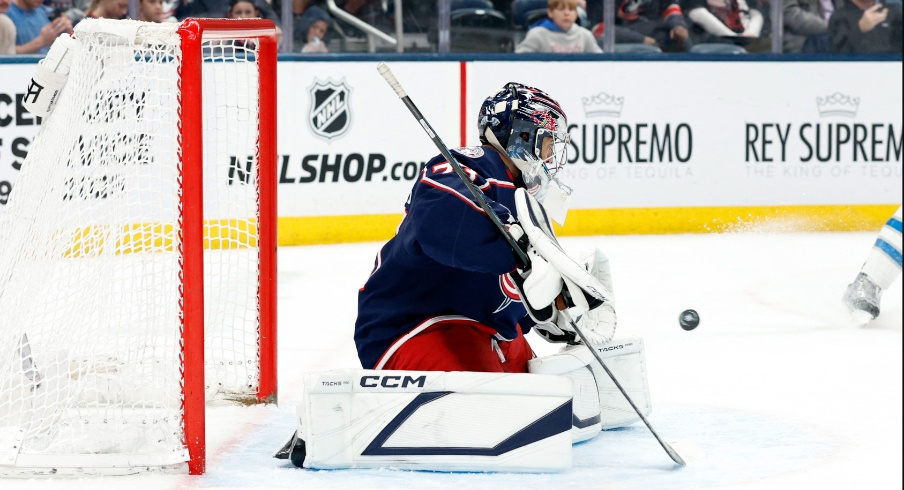
Entering the 2025-26 season, the Columbus Blue Jackets were hoping Jet Greaves could prove he belonged as an NHL starter.
It didn't take long for them to get their answer. By the time Rick Bowness was named head coach in early January, it was clear that Greaves was proving himself a more-than-competent number one goalie. And, while Bowness rotated between Greaves and Elvis Merzlikins in the beginning of his tenure as coach, it was made abundantly clear down the stretch that Greaves was (and is) Columbus' top netminder.
After 11 starts last season and just 20 in his NHL career entering 2025-26, Greaves appeared in a total of 55 games (53 starts) and posted a 26-19-9 record this season. Included in that was an above-average goals against average of 2.60 and an above-average save percentage of .908.
The goals against average ranked 7th among 28 NHL goalies who played in at least half (41+) of their teams' games, while the save percentage ranked 6th (and just .04 away from second).
Those are fairly elite numbers, especially considering the Blue Jackets were not a dominant defensive team in front of him. Greaves routinely faced significant pressure from the opposition and had to bail the team out of defensive lapses on an almost nightly basis, all while showing a remarkable ability to stay composed, track pucks through traffic, and make timely saves.
In other words, he kept Columbus in some games they probably shouldn't have been in.
But, as Greaves is set to become a restricted free agent on July 1, the question now shifts to whether or not Greaves is a top starter and the long-term solution for a Blue Jackets team that is ready to take the next step, or if he's simply (gulp) the next Columbus goalie to show a flash of brilliance before settling into mediocrity.
If “top starter” means a goalie who is (or soon will be) in the same class as names like Connor Hellebuyck, Andrei Vasilevskiy, or Igor Shesterkin, Greaves has not reached that level yet — even if his numbers were in the same ballpark this season. Those goalies have years of elite results, playoff success, and a much larger body of work.
Has he earned the top spot over Merzlikins and a substantial raise from his 2025-26 salary of $812,500, though? Of course.
That puts the Blue Jackets in a position to decide two questions in the coming weeks.
How much of a raise has he earned, and for how long?
Both questions have multiple answers.
One answer is a full commitment and a long-term extension. This would be risky. When Merzlikins looked like the next big thing at the beginning of the decade, the team signed him to a five-year, $27 million contract extension (an average annual value of $5.4 million), and as Merzlikins now enters the final year of that contract, it's proven to be a bad deal.
Five years (and a giant leap in the salary cap) later, and a similar commitment would likely cost the Blue Jackets between six and eight million dollars per season.
As good as Greaves was this season, do the Blue Jackets risk giving a long-term, big payday to a guy who still has less than one full season of starts under his belt? Greaves has only 73 career starts and 76 career games in the NHL.
If they do go big, it would be a significant commitment and would monetarily have to reflect the value of a proven No. 1 goalie. However, if Columbus truly believes Greaves is their franchise goalie, locking him in now could be the cheaper path — even the high end of that $6 million to $8 million window would look like a bargain in just a few years if Greaves does become and maintain “top netminder” status.
| GOALIE/TEAM | YEARS | DOLLARS | AAV | EXPIRES |
| Igor Shesterkin (NYR) | 8 | $92.0 million | $11.50 | 2033 |
| Andrei Vasilevskiy (TB) | 8 | $76.0 million | $9.50 | 2028 |
| Connor Hellebuyck (WPG) | 7 | $59.5 million | $8.50 | 2030 |
| Thatcher Demko (VAN) | 3 | $25.5 million | $8.50 | 2027 |
|
Ilya Sorokin (NYI) Jeremy Swayman (BOS) Jake Oettinger (DAL) |
8 | $66.0 million | $8.25 |
2031 (Sorokin) 2032 (Swayman) 2032 (Oettinger) |
The second option is a bridge contract, which would almost certainly be either a two-year or three-year deal.
A bridge deal would allow both sides to manage risk. The Blue Jackets would get more time to evaluate whether Greaves’ 2025-26 season was the beginning of something sustainable, while Greaves would have the opportunity to prove he belongs among the league’s highest-paid goaltenders.
A realistic bridge contract would likely land somewhere around $4 million to $6 million per season. Combine that with the length, and it would fall somewhere in the two-year, $8 million range and three-year, $18 million dollar range. Let's go in the middle: three years, $15 million.
This is the type of deal that would reward the 25-year-old Greaves for his performance while leaving room for a larger payday later, and would help keep the Blue Jackets out of a potentially bad contract.
The third option is one both parties want to avoid, which is merely another short-term contract. It would completely undervalue what Greaves became for the team and would send the message that they don't believe he's going to be able to maintain the success of his young career. The only realistic situation this type of deal happens in is one where the sides are in complete disagreement about where to go.
One unlikely scenario to keep in mind: as a restricted free agent, another team could sign Greaves to an offer sheet. If that happens, the Blue Jackets will get a chance to match any deal offered. If they don't, they receive draft-pick compensation from the team that signed him based on the contract’s value.
If a team offers $2.4 to $4.8 million (AAV), the compensation for the Blue Jackets would be a second-round pick — but Columbus would certainly match this offer. An offer of $4.8 million to $7.2 million would cost a team both a 1st and 3rd round pick, and an offer of $7.2 to $9.6 million would cost first, second, and third-round selections.
Don't worry too much about that — but it can't be completely ruled out. With the salary cap increasing big-time, teams have more money than ever to spend.
The Blue Jackets have finally found a goalie who looks capable of holding down the crease for the foreseeable future. Now, the challenge is deciding whether to bet on what Greaves has already shown or wait and see what he becomes next.
We'll know soon enough.