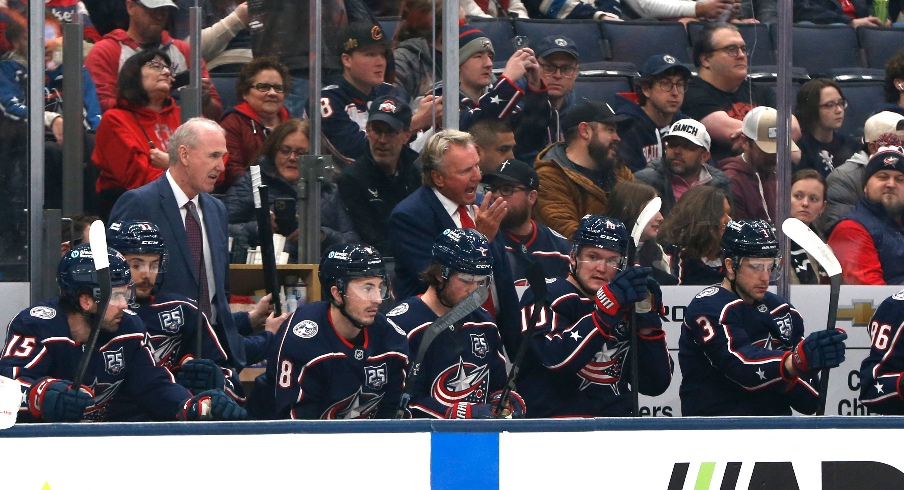
In a vacuum, what are the Columbus Blue Jackets?
They're good. Maybe a really good team if everything breaks right.
But are they great?
They feel like a team that can make the playoffs, but is that as a wild-card team, or as a team that can challenge for the division or one of the top three spots?
The Montreal Canadiens went from the dregs of the NHL standings in 2023-24 to being a wild card team in 2024-25, to finishing third in 2025-26, and tied with Tampa Bay with 106 points for second in the Atlantic Division. They got all the way to the Conference Finals.
The Sabres finally broke the 14-year playoff drought and won the Atlantic, losing in the second round to the Canadiens.
Carolina didn't become a perennial contender overnight. After breaking through in 2018-19, the Hurricanes experienced early playoff exits before eventually becoming one of the NHL's most consistent contenders, culminating in their second Stanley Cup.
Those teams didn't just end playoff droughts. They changed how they were viewed. They went from teams hoping everything broke right to teams expecting to win.
Only three teams qualified for the playoffs in the Metropolitan Division, with the Capitals (95 points), Blue Jackets (92), Islanders (91), Devils (87), and Rangers (77) all missing the cut. You can count on the division being tough once again this season and needing at least 100 points to feel good about your playoff aspirations. There are now 84 games, so maybe aim a little higher.
Do the Blue Jackets really stack up?
That's become the defining question surrounding this franchise. Not just whether they can make the playoffs, but whether they've closed the gap between being a playoff hopeful and becoming one of the Eastern Conference's true contenders.
When you get past the playoff-bubble conversation for this team, can they actually raise the bar so much that they're like some of those other teams that not only ended droughts and did damage in the playoffs?
The uncomfortable reality surrounding this team is how much uncertainty exists, and it feels like this is the season they have to make everything really count.
It always kind of feels like the Blue Jackets' puzzle pieces are out of place. Head coach Rick Bowness, the club's fifth head coach — counting Mike Babcock — since 2021-22, is on a one-year deal. Zach Werenski is in his prime and can leave as an unrestricted free agent in two years. Adam Fantilli is still ascending, while Denton Mateychuk (13 goals, 18 assists, +12) is just beginning what the organization hopes is the start of a very long NHL career. The Blue Jackets have veterans trying to win now and young players still growing into their potential. They have talent. The timelines don't always feel aligned.
Marchenko's future has also become part of the larger question surrounding whether Columbus can become a destination for its own star players.
The Blue Jackets are trying to compete while still figuring out what their next version looks like.
Ultimately, the only way to quiet those questions is by winning. Playing meaningful hockey in March and April would do more to shape the franchise's future than any press conference or contract negotiation.
If Columbus makes the playoffs, it can be viewed as a successful season. If Florida or Carolina simply squeak into the postseason, it's viewed as a disappointment. That's the difference between being a hopeful and being a contender.
But there are so many previous years of failure in Columbus and star players wanting out, such as the 2018-19 club — the franchise's best season to this point — that kept everyone together and went all in. Those players left. Past success, or failure, doesn't indicate future success, or failure, but you can understand those who have seen this episode before and don't have the greatest feeling about this franchise's track record.
The franchise hasn't yet escaped the perception created by years of disappointment and star departures.
What about the rest?
Right now, the Blue Jackets feel more like a team trying to be an annual playoff participant than one expected to fight for the top of the Metropolitan Division.
That doesn't mean Columbus can't take another step. Teams can change quickly in the NHL. But the next step is the hardest one: moving from a team people believe can make the playoffs to a team people believe can win once it gets there.
